Why does everything feel a little worse today?
I recently came across a short video that asked a surprisingly simple question:
Why does everything feel a little worse today?
Not necessarily more expensive. Not slower. Just… less satisfying.
Products are packed with more features than ever before, customer journeys have been streamlined, businesses measure everything, automation is everywhere – yet many experiences somehow feel less personal, less memorable, and ultimately less valuable.
The video referred to two ideas that have stayed with me ever since: Rory Sutherland’s “Doorman Fallacy” and Chesterton’s Fence.
Both describe a pattern that extends far beyond hospitality or retail. They explain what happens when businesses become so focused on efficiency that they unintentionally remove the very things customers valued most.
The Doorman Was Never Just Opening the Door
Rory Sutherland uses the example of a hotel doorman.
If you only measure the obvious part of the job, opening the door, replacing that person with an automatic entrance seems like an obvious improvement.
It’s cheaper. It’s faster. It’s more efficient. But the doorman wasn’t simply opening doors.
He recognized returning guests. He noticed unusual situations. He helped with luggage. He answered questions before they were asked. Most importantly, he created a feeling that somebody cared.
None of those contributions appeared on a spreadsheet. Yet together they often shaped the entire customer experience. Once the role disappears, the building still functions perfectly. But somehow it doesn’t feel the same anymore.
Optimizing What We Can Measure
Modern businesses have become exceptionally good at measuring performance.
We track response times. Conversion rates. Clicks. Cost per acquisition. Automation ratios. Operational efficiency.
These metrics matter.
We should absolutely measure them.
The problem begins when they become the only things we optimize. Trust doesn’t appear on a dashboard. Long-term relationships don’t fit neatly into quarterly reports. A customer who recommends your company to three others because they genuinely enjoy working with you creates enormous value – but it is difficult to attribute inside analytics software.
And because it is difficult to measure, it often receives less attention.
Chesterton’s Fence
More than a century ago, G.K. Chesterton described a principle that has become surprisingly relevant today.
If you encounter a fence and don’t understand why it exists, don’t remove it until you understand its purpose.
Businesses often ignore this advice. Processes disappear because they seem inefficient.
Support teams become smaller. Customer interactions become automated. Experienced engineers are replaced with layers of software. Documentation becomes AI-generated. Relationships become tickets.
Sometimes these changes genuinely improve the business. Sometimes they simply remove something nobody realized was creating value. By the time customers begin noticing the difference, rebuilding that trust is far more expensive than preserving it would have been.
Technology Should Remove Complexity – Not Humanity
At HORISEN, we spend every day building software that automates highly complex messaging operations.
Automation is essential.
Without it, modern messaging simply wouldn’t function.
But we have also learned that there is an important distinction between automating repetitive work and removing human value. Those are not the same thing. Our goal has never been automation for its own sake.
It has been to remove operational complexity while allowing people to focus on the work where experience, judgement and relationships matter most. Technology should eliminate unnecessary effort. It should never eliminate the reasons customers enjoy working with you.
The Features Customers Remember
Interestingly, customers rarely remember the feature list.
They remember how implementation went. How quickly somebody answered when something unexpected happened. Whether the platform remained stable during their busiest period. Whether they felt listened to. Whether somebody genuinely understood their business.
Those experiences rarely appear in product brochures.
Yet they often determine whether a customer stays for ten years – or starts looking elsewhere.
Building for the Long Term
In software, there is constant pressure to build more.
More integrations. More dashboards. More AI. More features.
Sometimes those investments are exactly what customers need.
Sometimes the better decision is improving reliability, simplifying workflows or investing in infrastructure that customers may never even notice.
Those improvements don’t always create exciting marketing headlines. But they create something much more valuable:
Confidence.
And confidence is remarkably difficult to replace once it is lost.
Sometimes the Best Investment Is Keeping the Doorman
Efficiency will always matter. Innovation will always matter. Technology should continue making businesses faster and more capable.
But perhaps the next competitive advantage won’t come from removing every human interaction. Perhaps it will come from understanding which ones were quietly creating value all along. Because sometimes the most important part of a business is the one nobody thought to measure.
And sometimes, the doorman wasn’t just opening the door.
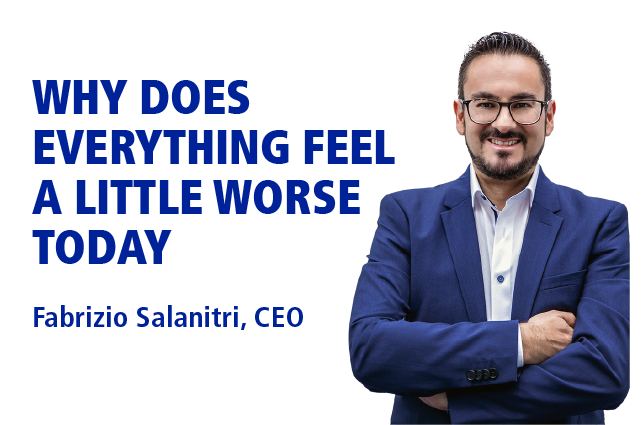
Fabrizio Salanitri
Founder & CEO, HORISEN
Sources:
Rory Sutherland, Alchemy: The Dark Art and Curious Science of Creating Magic in Brands, Business, and Life (2019); related talks on behavioural economics and the “Doorman Fallacy.”
G.K. Chesterton, The Thing (1929), origin of Chesterton’s Fence.
Joseph Pine II & James H. Gilmore, The Experience Economy (Harvard Business School Press).
Daniel Kahneman, Thinking, Fast and Slow (2011), on the difference between experiences and remembered value.
Harvard Business Review, various research articles on customer experience, trust, and long-term business value.