What You Can’t See from Across the Exhibition Hall
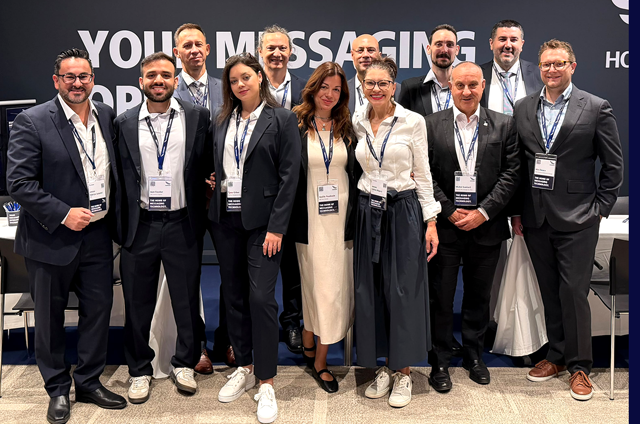
This week, many of us from HORISEN are in Madrid for Wholesale World Congress. We came with a strong team. And I think that says something important about wholesale.
From the outside, wholesale messaging can sometimes sound relatively straightforward: traffic moves from one company to another until a message reaches its destination. Anyone who has actually worked in this business knows how much sits behind that simple description.
Behind every message are commercial relationships, routes, suppliers, quality decisions, pricing, margins, regulation, fraud prevention, technical infrastructure, finance and, ultimately, people.
A message can cross systems, networks, operators, countries and commercial relationships before it reaches the person holding the phone.
Wholesale is part of the largely invisible machinery that makes that possible. And events like WWC bring many of the people operating that invisible layer into one room.
Wholesale Makes Relationships Operational
I have written before about why, after so many years in telecommunications, I still value industry events. It is not really because of the exhibition itself. It is because of the people and the conversations.
Wholesale takes that idea one step further. This industry runs on relationships, but those relationships have very practical consequences.
One company trusts another to carry something onward. A route depends on another network. A commercial decision can affect a technical outcome. A change in quality can affect a customer relationship. A fraction of a cent can matter enormously when multiplied across millions of transactions.
Commercial and technical decisions are constantly connected.
Perhaps that is one reason wholesale remains such a relationship-driven business despite becoming increasingly automated. Technology executes much of what we do. But people still decide whom they trust to execute it with.
Walking around WWC this week, however, made me think about another characteristic of our industry. From across an exhibition hall, many things can look remarkably similar.
From a Distance, Similarity Is Easy to See
Walk past enough booths at almost any technology event and you will encounter familiar language.
Automation. AI. APIs. Routing. Quality. Margins. Connectivity. Efficiency.
You will see dashboards, diagrams, platforms and demonstrations.
Naturally, every company is trying to explain why its approach is different.
But there is an interesting psychological phenomenon here.
In the 1930s, German researcher Hedwig von Restorff studied what happens when one item differs from the things surrounding it. Her work became associated with what is now known as the von Restorff effect, or the isolation effect: under the right conditions, something that is distinctive within its context is more likely to be remembered.
What I find particularly interesting is the role of context.
Distinctiveness does not exist entirely on its own. Something stands out because of how it differs from what surrounds it. Modern research on distinctiveness continues to emphasize this relationship between difference and similarity.
In marketing, the obvious conclusion would be simple: If you want to be remembered, look different.
After many years building technology, however, I think there is another side to that idea.
Looking different is relatively easy. Being meaningfully different is much harder.
The Closer You Look, the More the Details Matter
From twenty metres away, two platforms might appear to solve the same problem. Move closer and start asking questions, and the differences become more interesting.
How does the workflow actually work?
What happens when something goes wrong?
How quickly can someone react when conditions change?
What happens when the normal use case becomes an exception?
How easily can commercial teams see what is happening technically?
How much manual work is hiding behind something described as automated?
And what happens after the demonstration, when the technology has to become part of someone’s everyday business?
These are not necessarily the things you notice from across an exhibition hall. But they are often the things that determine whether technology really works.
The closer you get, the more differentiation moves away from what you can see and towards what you can experience. That distinction has become increasingly important to me over the years.
What You See Is Only the Result
There is another concept that helps explain why.
Philosopher Michael Polanyi wrote extensively about tacit knowledge: the idea that part of what we know cannot easily be reduced to explicit instructions or documentation. His work starts from a wonderfully simple observation: human beings can know more than they can fully articulate.
I think about this often when it comes to technology.
A finished interface does not show you all the discussions that determined how it should work. A workflow does not show you all the edge cases that came before it. A feature does not tell you which earlier versions failed. A button does not explain why it is there. And a product demonstration cannot show you the years of customer conversations, development decisions, operational problems and commercial experience that shaped what you are seeing.
Once the answer exists, it can sometimes look obvious. But there is a great deal of knowledge hidden inside a good answer. Perhaps that is also why I have become quite relaxed about another reality of the technology business.
Good ideas travel.
Sometimes you recognize an idea somewhere else. Sometimes it is terminology. Sometimes communication. Sometimes even an element of an interface begins to look familiar.
After enough years in technology, that stops being particularly surprising. Because what is visible is naturally the easiest part to reproduce.
What is much harder to reproduce is everything that made it work in the first place.
You can see the answer. You cannot immediately inherit all the questions, mistakes, conversations and experience that taught someone how to arrive at it. And eventually, those things show. Usually in the details.
The Questions After the Demonstration
This is why I enjoy conversations with experienced wholesale people.
They rarely stop at what something does. They want to know what happens next. And then what happens if that does not happen. And what happens in the unusual situation that occurs perhaps once in a thousand transactions but matters enormously when it does.
Those questions come from experience.
They are also difficult to anticipate if you have never actually lived the problem you are trying to solve.
Perhaps that is one reason we have so many colleagues here in Madrid this week.
Wholesale is not one conversation.
It is commercial, technical and operational at the same time.
One discussion can begin with traffic, move into routing, continue into margins, touch signalling, involve finance and finish with a completely different operational challenge.
No single perspective tells the whole story. And I think good technology is built in much the same way. It comes from bringing those perspectives together repeatedly until the details begin to make sense.
What You Cannot See from Across the Hall
The von Restorff effect tells us something fascinating about attention and memory: difference matters. Things that stand apart from their context can become easier to remember.
But business has taught me something slightly different about differentiation.
The most important differences are not always the ones designed to attract attention.
Sometimes they are almost invisible.
They are in how quickly someone can complete a task. In an exception that has already been considered. In two systems that communicate properly. In information appearing exactly where somebody needs it. In a process that feels obvious precisely because someone spent years making it that way.
You will probably never see most of those things from across an exhibition hall.
So walk closer. Ask another question. Look beyond the headline. Open the technology.
And look at what happens behind the obvious workflow.
That is usually where the differences begin to appear.
After more than 25 years in wholesale messaging, I have learned that the biggest differences are rarely the loudest ones.
The devil, as they say, is in the details.
Fabrizio Salanitri
Founder & CEO, HORISEN